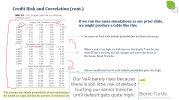
When we built Table 8.4, we wanted to highlight this dynamic.
The Senior Tranche VaR can look surprisingly large, and we know that raises eyebrows. After all, the whole pitch of the senior tranche is that it is the safe piece of the structure. But notice what we annotated right on the slide: the senior bond is "almost unaffected at rho=0 until default probability gets very high." That is the key to everything.
Look at the numbers in the Senior Bond VaR section of the table. At low default probabilities, the VaR is essentially zero across the board. The equity and mezzanine tranches below the senior are absorbing all the pain. The senior tranche sits there collecting its coupon and losing nothing. But watch what happens as the default probability (pi) climbs toward 0.0975. The Senior VaR starts jumping significantly, particularly once correlation (rho) is elevated too.
That is the scenario we wanted students to internalize. The senior tranche only gets hurt when almost everything in the underlying pool blows up at once. When that happens, the junior tranches have already been completely wiped out, and the losses hit the senior tranche directly and in large amounts. We flagged this in the callout box: "Our VaR barely rises because there is still little risk of default hurting our senior tranche until default gets quite high!"
So the large VaR number is not telling you the senior tranche loses often. It is telling you that when it does lose, it loses in a big way. VaR at 99% confidence is picking up that tail scenario, and the senior tranche, which carries a large notional, takes a significant hit in those catastrophic cases.
Compare it to the Equity Tranche in the same table. Equity VaR actually peaks in the middle range of default probabilities and then comes back down. That is because at very high default rates, equity is already fully wiped out, so there is no further surprise. The senior tranche has the opposite problem: it looks great right up until the moment it does not.
This site uses cookies to help personalise content, tailor your experience and to keep you logged in if you register.
By continuing to use this site, you are consenting to our use of cookies.