de Servigny - Default Risk Quantitative Methodologies

brian.field

Well-Known Member
Subscriber
I am reading de Servigny's Default Risk Quantitative Methodologies chapter from the GARP printed textbooks.
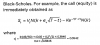
Page 69 references the Black-Scholes pricing model for the value of a firm's equity under the Merton model.

Interestingly, the formula does not reference d1 yet the expression is immediately followed by a "where d1 = ..." statement.
upload_2015-2-18_15-43-16.png

Does any know if this is a careless GARP error or does the actual de Servigny text also have the same error?

Obviously, we recognize d1 from the Black-Scholes model.

Best,

Brian
 
In fact, I can't seem to find from where the numbers in the d1 expression came! Perhaps they were presented in Chapter 1 or 2 of the de Servigny text.
 
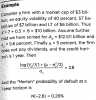
Another question here: Page 71 presents the following:

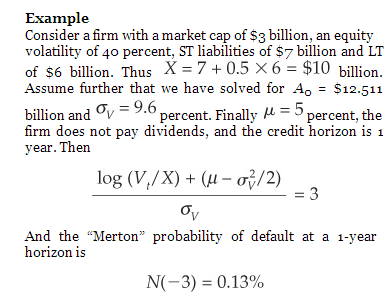
I do not see how the author is coming up with 2.8. Then, he uses the negative in the N() function. This is not presented very clearly.

Assume the following:

V = 3BB
X = 10 BB
mu = 5%
sigma = 9.6%

Do you come up with 2.8?

Also, why does the author change the sign of the 2.8?


upload_2015-2-18_16-8-42.png
 
Yes Brian in your first post d1 is not explicity mention in merton version of the BSM. I think the author took d2 as k and mentioned d1 as k+sigma*sqrt(T-t) as relation d1-d2=sigma*sqrt(T-t) holds. Its a silly mistake in terms of using wrong notation.
Thanks
 
Yrs Brian the answer do come to 2.8,
In merton model replace everything of equity in Bsm with asset, plug in the values and calculate[ log(12.511/10)+(.05-(.0196^2*.5))]/.0196*1
Vt is the current value of firm's assets=12.511b,X is debt of firm current=10b,mu=expected return of firm=.0,sigma(v) is volatility of firms assets which we assummed as equity'volatility itself because asset=equity+debt and Var(asset)=Var(equity)+Var(debt)+2*corr(debt&equity)*sigma(equity)*sigma(debt)*w(e)*w(debt) because sigma(debt)=0 which is assumed in the model therefore Var(asset)=Var(Equity) or sigma(asset)=sigma(rquity).
What we get in the end is N(-d2)(d2=2.8) which is nothing but the probability of asset price falling below the debt or firm defaulting.The N(d2) is the probability that asset price shall exceed debt thrrefore 1- N(d2) is probability of asset price falling below debt we can write 1-N(d2) as N(-d2) for normal cum probability distribution.Similar to Bsm where N(-d2) is the probability of stock price falling below exercise price X.
Thanks
 
Last edited:
Thanks Shakti.....perhaps I am being careless myself.

Your expression does not equal 2.8 as far as I can tell. Rather, LOG(12.511/10) + (0.05 - (0.0196^2*0.5)) / 0.0196*1 = 2.6385.

Also, why would the author define V as 3 BB (market cap) and then give Ao = 12.511 BB without defining what Ao is? I assumed V = 3 BB.

Also, where are you getting the 0.0196? Sigma is defined as 0.096 no?
 
Yeah sigma should be .096 instead of .0196, now check Brian 2.8 shall come,i have checked it. Vt is denoting A0 only Brian.
Thanks
 
(Log(12.511/10) + (0.05-(0.096^2)*0.5))/0.096 = 1.49 whereas (LN(12.511/10) + (0.05-(0.096^2)*0.5))/0.096 = 2.8

Isn't that amazing?

The author reports Log but is actually using LN. Another example of outrageous carelessness that wasted a significant amount of time! :) He could have indicated that the base was e.
 
Last edited:
Yes thats very careless in the author' side i had taken the base as e only. And in these merton and bsm we usually use e as bade for log terms.
Thanks
 
Just realized after looking at the Study Notes for de Servigny.

The Distance to Default is d2 from the B-S model and the Merton PD is N(-d2) which explains why the 2.8's sign switches in N(-2.8) above.
 
Hi @brianhfield

I am confused by the GARP books because here is the screenshot from the source De Servigny (kindle version):
0224-default-ch3-book.png


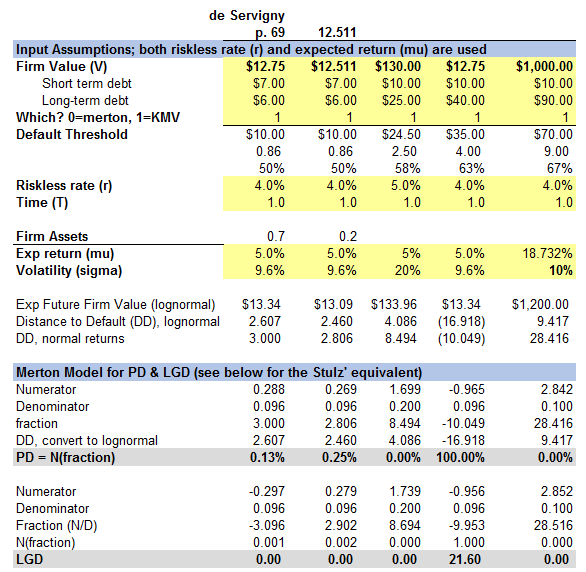
Here is the sheet from my XLS, which can be opened here at @ https://www.dropbox.com/s/cxogqan42xkbrtj/0224-default-ch3-actual.xlsx?dl=0

Please notice:
  • The first column is my (longstanding) assumption of firm value, V(0) = $12.75 in order to make the DD = 3.0 per the reading. Then PD = 0.13%
  • The second column uses V(0) = $12.511 which returns PD = 0.25% (only because mine does not round the DD to 2.8).
  • This shows that both use the basic Merton model correctly, FWIW
0224-default-ch3-xls.png
 
Last edited:
Top