Level 2: Post what your remember here...

If your memory is correct, which I strongly believe it is because I got 32.5 and I am quite certain I used the Libor from the end of the period. But sorry to tell you, Majesta, that it is wrong. We are supposed to use Libor from the start of the swap (see my earlier post today with Hull's screenshot). So the correct anwer I believe is 33.5 (200*20% - 200*3.25% = 40 - 6.5 = 33.5). In any case, I know that I screw this one up as I used the Libor from the end...

Well I think GARP was like assuming that the 0.75% was like another start which was slightly the past of before the index soared to 11400. That's the only thing we can come up with for this Q. The options only contained 31.5 and 32.5 I believe
 
Well I think GARP was like assuming that the 0.75% was like another start which was slightly the past of before the index soared to 11400. That's the only thing we can come up with for this Q. The options only contained 31.5 and 32.5 I believe
The answer was 31.5

I don't remember the question as precisely as I did on the day of the exam. But, using the starting LIBOR, the payouts were -40 and +8.5
 
David, Thank you for answering most of my queries. I did learn quite a bit from your posts and the posts from other users here. It seems GARP likes to repeat questions going by the posts made by test takers in the previous years. I am referring to a couple of them, namely the ES@95.5% confidence and the BASEL question regarding which model explicitly incorporates diversification. I came across the latter in your PQ. Also, I was able to answer the question on loan equivalent RAROC as I had looked at one of your examples in the slides a couple of days before the exam. Although, you said that GARP would not likely test us on the mechanics of the High-water mark. They did test it, but I was able to answer that one as well because I decided not to leave anything to chance. :)

Hi laxsun, thanks for the feedback, really appreciated. In regard to the high-water mark, I think you refer to my comments here appended to the associated practice question here (a question which itself includes a quantitative application). Given the AIM reads "Discuss" and not "Calculate," I am indeed surprised there was a quantitative high-water mark question.

This is a constant struggle for me because: as the exam nears, a highly popular question for us is 'Will this be tested?' I always try to first qualify with "I cannot predict with certainty" etc, but I do try to give an informed best guess as to what I call "testability." But this (assuming a quantitative question was asked of a an AIM with "Describe") sort of illustrates a "feature" of the exam methodology: the AIMs can be a little loose.
 
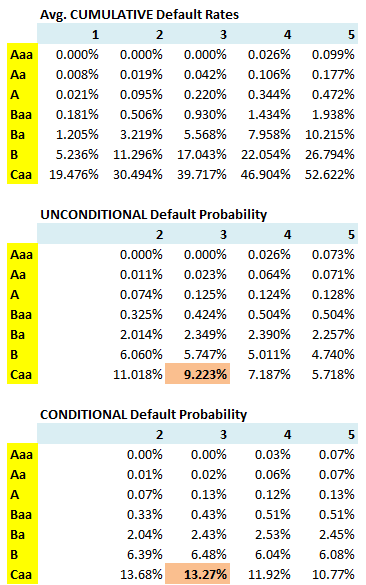
In case it's helpful, with respect to the discussion re: cumulative vs. conditional PDs above. While i can't discern the exact question, I wanted to share a screen from the 6.3.c learning XLS, below, which merely elaborates on Hull's exhibit shared by troubleshooter here @ http://forum.bionicturtle.com/threads/level-2-post-what-your-remember-here.5923/page-11#post-17871

please note:
  • If we are given cumulative default rates; e.g., 2-year cumulative PD [Caa-rated] = 30.494% and 3-year cumulative PD [Caa-rated] =39.717%, then:
  • The unconditional PD [Caa] during the third year = 39.717% - 30.494% = 9.223%
  • The conditional PD during Year 3 = 9.223%/(1-30.494%) = 13.27%
  • Not shown, but hazard rate (aka, default intensity) connotes an instantaneous(continuously compounding) conditional PD, such that (as usual, compound frequency matters!) we can also compute a (instantaneous) hazard rate = -1/T*LN(1 - cumulative PD) = -1/3*LN(1-39.717%) = 16.87%; ie., the hazard rate implied by the 3-year cumulative PD, which could then be reversed back into the cumulative PD with the exponential function (see Rachev): cumulative PD = 1 -exp(-lambda*T); ie, given hazard rate 16.87%, 3-year cumulative PD = 1-exp(-16.87%*3) = 39.72%. I hope that helps, thanks,
0522_hull_pd.png
 
If I remember this correctly, the question was for third year default intensity for Baa with the same numbers as the spreadsheet here. I think the answer was 0.426...
 
Certainly - Decline in stock price provided an opportunity to increases the cash flow - Coupon is mere a static cash flow (not an increase)

http://www.barclayhedge.com/researc...edge-fund-strategy-convertible-arbitrage.html

The idea behind convertible arbitrage is that a company’s convertible bonds are sometimes priced inefficiently relative to the company’s stock. Convertible arbitrage attempts to profit from this pricing error.

To illustrate how convertible arbitrage works, a hedge fund using convertible arbitrage will buy a company’s convertible bonds at the same time as it shorts the company’s stock. If the company’s stock price falls, the hedge fund will benefit from its short position; it is also likely that the company’s convertible bonds will decline less than its stock, because they are protected by their value as fixed-income instruments. On the other hand, if the company’s stock price rises, the hedge fund can convert its convertible bonds into stock and sell that stock at market value, thereby benefiting from its long position, and ideally, compensating for any losses on its short position.

I'm still not convinced on this one. A stock price decline would mean the delta hedge needs to be rebalanced. Since the hedge is short the stock vs long delta on the CB, they would need to buy stock to rebalance. This would be a cash outflow. However I don't recall whether the question specified the direction of the cash flow increase.

The other options were Dividends,Coupon and PB fees. I chose Coupon because it was the only +ve cash flow.
 
I'm still not convinced on this one. A stock price decline would mean the delta hedge needs to be rebalanced. Since the hedge is short the stock vs long delta on the CB, they would need to buy stock to rebalance. This would be a cash outflow. However I don't recall whether the question specified the direction of the cash flow increase.

The other options were Dividends,Coupon and PB fees. I chose Coupon because it was the only +ve cash flow.
I too chose coupon as +ve cash flow. I am not convinced about the logic of coupon being "static cash flow". It's not an easy one to be certain either way.
 
Hi Robert & Troubleshooter,

Below is from BT note on T8.d R&I note pg 31.

Explain the common arbitrage strategies of hedge funds, including: Convertible arbitrage
2012 FRM Risk & Investment Management 8.c Stowell, Hedge Fund Invest Strategies: Ch. 12

Returns: The returns in a convertible
arbitrage are generated from three sources:
•Income generation: This is the
straightforward income from the
convertible bond hedge
•Monetizing Volatility: By creating a
delta neutral position, the arbitrageur
can also create an additional gain. In an effective strategy, if the stock prices fall, the gain from the short position could be greater than the loss from the long convertible bond position, and vice-versa.
•Purchasing of undervalued convertible: If the arbitrageur has purchased an undervalued convertible bond, compared to its theoretical value, then this can generate additional profits. These profits increase with increase in volatility.

This is the way it is in the note. You can also confirm from the core reading.

BR

EIA


Hi David, I will really appreciate if you can please comment on this one.


Many Thanks
 
Here's an attachment with the extract of the questions that were remembered by our posters here. Thanks to all for posting the questions. There was total of 76 out of 80 questions accounted for.

I have about 58/76 correct which translates to about 61/80. This is based on pretty harsh marking;); Guesses and unsure assumed to be wrong. Based on my previous analysis, 60 should be a certain pass (assuming criteria of top 5% score 95% and pass mark is set at 80% of that which is also pretty harsh I guess.). So I am feeling comfortable at getting a pass... Best of luck to everyone... :)...

Thanks David for all the guidance...
 

Attachments

  • FRM.doc
    64.5 KB · Views: 42
Hi EIA,

I don't see the question about the convertible? But the quoted notes look correct and consistent with the FRM knowledge base (including previous Jaeger) on convertibles. If we here refer to a vanilla convertible strategy which is long the convertible bond plus short the stock in a delta-neutral hedge, then there are three sources of return (or two, depending)
  1. static (income): coupon + short rebate (ie, interest) - borrowing cost - stock dividends
  2. gamma trade (i.e., long volatility): the long convertible is long vega and long gamma. This is non-directional profits earned on the volatility due to the positive gamma created by the option. Essentially the same as volatility profits on [long call option + short delta share]. Positive gamma here means that convertible delta is an increasing function of stock price (see Stowell Figure 1); under a dynamic delta neutral hedge (ignoring transaction costs), the produces a net gain in either direction.
  3. price inefficiencies (ie., buy cheap, sell expensive). Sometimes this (3) is grouped with (2) such that there is static (income) and trade (capital) sources of return. I hope that helps,
 
Hi EIA,

I don't see the question about the convertible? But the quoted notes look correct (and consistent with the FRM knowledge base including previous Jaeger) on convertibles. If we are refer to a vanilla convertible strategy which is long the convertible bond plus short the stock in a delta-neutral hedge, then there are three sources of return (or two, depending)
  1. static (income): coupon + short rebate (ie, interest) - borrowing cost - stock dividends
  2. gamma trade (i.e., long volatility): the long convertible is long vega and long gamma. This is non-directional profits earned on the volatility due to the positive gamma created by the option. Essentially the same as volatility profits on [long option + short delta share]. Positive gamma here means that convertible delta is an increasing function of stock price (see Stowell Figure 1); under a dynamic delta neutral hedge (ignoring transaction costs), the produces a net gain in either direction.
  3. price inefficiencies (ie., buy cheap, sell expensive). Sometimes this (3) is grouped with (2) such that there is static (income) and trade (capital) sources of return. I hope that helps,


David,
There was only viable choices on this convertible arbitrage that asked when you get an increase in CF - 1. Coupon on the bond 2. Share price going down. So does you answer above mean it would be coupon?
 
Here's an attachment with the extract of the questions that were remembered by our posters here. Thanks to all for posting the questions. There was total of 76 out of 80 questions accounted for.

@troubleshooter, thank you for sharing the summary. The question of ethical post-exam sharing was earlier raised. I consider your particular post ethical and compliant with GARP's standard, as it does not replicate the entire Q&A in detail. We have received the official guidance. Please note that GARP is not opposed to exam postmortem discussion, as I was informed yesterday: "General recollections of exam questions is fine and I believe a valuable resource for candidates (and exam prep providers!)."

As a practical matter, a good way to help with compliance is to omit the four answers offered, this helps to avoid an exact "stem plus answer choices" replication.

GARP's official guidance:
Candidates can share general recollections of exam questions, which we believe to be a valuable resource for candidates and exam prep providers, but candidates should not share detailed replication of any exam question in any forum. At registration, candidates agree to abide by the Code of Conduct which states that they shall not engage in any conduct or commit any act that compromises the integrity or validity of the examinations. And on Exam day, all candidates sign a “Registrant Agreement” whereby it is written that all exam material is copyrighted and cannot be shared publically without GARP’s permission.
 
David, There was only viable choices on this convertible arbitrage that asked when you get an increase in CF - 1. Coupon on the bond 2. Share price going down. So does you answer above mean it would be coupon?

Hi troubleshooter, It's not enough information for me: assuming a dynamic vanilla convertible, ANY of the sources of return could manifest as in increase in cash flow (Stowell's Figure 1 will demonstrate this, i would think). Wording matters (if the convertible bond position doesn't change, the coupon cash inflows would not increase any more than fixed coupon cash flows don't change, so I'm not understanding the exact meaning of "increase"). If the share price goes down, the dynamic arb trade is buy shares (reduce the short share position) which is an outflow. So, neglecting dividends, I think the basic dynamic of "share pricing going down" is net M2M gain but cash outflow = zero inflow (due to unrealized capital gain on short) - outflow to purchase shares. "An increase in cash flow" is insufficient for me .... my initial reaction is neither creates an increase in cash flow (why would the coupon increase? share price down implies net cash outflow but capital gain) but it requires assumptions ... sorry, thanks,
 
I agree. I guess it's one of those badly worded questions where it can interpreted in many different ways. Your luck rests on your interpretation. I will not decisively blame GARP for this as I did for the DV01 gap question... Anyway, thanks for taking your time... And thanks for getting GARP's guidance on post exam discussions. Seriously, I did not want to get into trouble for discussing the exam in a public forum...
 
Sure thing - I forwarded feedback on the "DV01 gap" question to GARP directly, on its own, to three of my contacts at GARP. I wrote them "I would find it hard to believe it possible this error could get to an actual exam." Yet it appears possible. (officially, they won't confirm as that would open a can of worms.). As much as i would love to see the actual exam, i have come to understand why they cannot publish it, and I am almost relieved they won't.

On this commitment to quality, all i can say is here is how i feel about it: :(:mad::confused::eek:
although the order might be: :mad::confused::(:eek: (I was mad and confused for a while [how is this possible?] ... now i'm just sad and concerned)
 
On the Liquidity Duration Question. Given a position in one security with an average daily volume as well as a position, it was easy to solve for the liquidity duration of each. However, in the answers, I might've chosen the maximum of the two. For instance, if one position takes 4 days to liquidate and the other 8, I would think it would take 8 days to liquidate the portfolio. However, the only answers feasible were 6 or 12. Most people on this forum chose 6, as the average of the two. However, I chose the sum of them, as the average really doesn't make much sense. If one has 200 securities and 199 of them could be liquidated in a day and the remaining one takes a year, I would not think the portfolio's liquidity duration is the average of the 200. However, I could not find the definition of the liquidity duration of a portfolio. As my logical (max of an individual position) was not a choice, I thought sum made more sense than the average. Any opinions?
 
On the Liquidity Duration Question. Given a position in one security with an average daily volume as well as a position, it was easy to solve for the liquidity duration of each. However, in the answers, I might've chosen the maximum of the two. For instance, if one position takes 4 days to liquidate and the other 8, I would think it would take 8 days to liquidate the portfolio. However, the only answers feasible were 6 or 12. Most people on this forum chose 6, as the average of the two. However, I chose the sum of them, as the average really doesn't make much sense. If one has 200 securities and 199 of them could be liquidated in a day and the remaining one takes a year, I would not think the portfolio's liquidity duration is the average of the 200. However, I could not find the definition of the liquidity duration of a portfolio. As my logical (max of an individual position) was not a choice, I thought sum made more sense than the average. Any opinions?
Max definitely makes sense. Sum does not make sense as you do not have to wait for one of them to be fully liquidated before you begin with the other one. I think LD came out as 4.xx and 5.xx. The choices were at 5, 10, and higher than 10 values. I would think 5 was the best answer.
 
@jdg123 - I am aware of no definition for "liquidity duration" in any of the assignments. Admittedly, I've only read them a few dozen times, so maybe i missed it :rolleyes: but even Google doesn't give me solid references. I'd appreciate any legitimate reference ... I can see that it sounds like an average days to liquidate or something ... (it sounds to me like an abuse of "duration" frankly)
 
Top