Model 3 and 4

bpdulog

Active Member
Hi,

I tried to search Model 3 but the search didn't come up with anything meaningful.

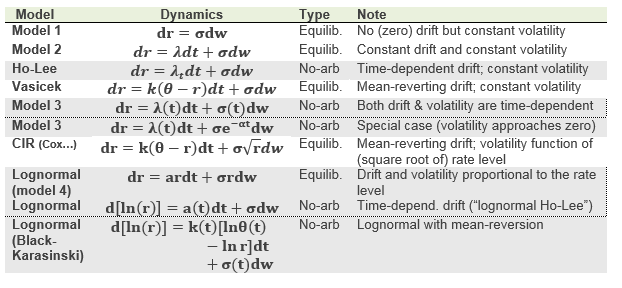
Models 3 and 4 both have an alpha factor in them, yet the text doesn't define what alpha is. So what does this alpha factor represent and are we expected to derive it on the exam or will it be provided? Thanks
 
@bpdulog These alphas are merely parameters which manifest as constants in the models that allow for customized sensitivity; or, in the case of Model 3 (which is a no-arbitrage model) presumably the alpha constant adds flexibility that better enables fitting of the model to observed rates. In the case of Model 3 where the alpha enables the special case of modeling a volatility that tends toward zero, you have a constant that might be loosely likened to the smoothing parameter in EWMA volatiltiy, but in this case is determining the "speed" of reversion to zero. If alpha = 10% and volatility is, say, 20%, then you have σ*exp(-α*t) which is 18.1% at t=1, then 16.37% at t = 2, and conveniently (analogous to the exponential weights in EWMA which have constant ratios), the ratio of consecutive volatilities is constant over time at 16.37%/18.10% = 0.905, so the volatility at t = 3 is 16.37%*0.905 = 14.82%. If we increase alpha, the speed of reversion toward zero increases. So it's elegant and compact in that way. Similarly, with Model 4, the (a) modifies the sensitivity of the relationship between the drift and the level of the rate, r. I hope that's helpful!

1213-tuckman-summary.png
 
Top